Shortest Path Attack
What is a Shortest Path Attack?
The Shortest Path Attack models an attacker who always chooses the most efficient route to reach a high-value target in an Active Directory environment.
It is based on graph distance minimization, not on a specific exploitation technique.
Definition (Project Scope)
A Shortest Path Attack is defined as:
The minimum-length path in the graph between a source node (User or Computer) and a target node (high-value object).
Key Idea
Instead of exploring or branching, the attacker assumes full visibility of the graph and selects:
- the fastest possible escalation route
- the fewest number of steps
- the lowest operational cost path
This reflects an optimized attacker strategy.
Path Composition
The shortest path may include multiple relation types:
MemberOf(group membership)GenericAll,WriteDACL,WriteOwner,GenericWrite(ACL abuse)HasSession(active sessions)AdminTo(local admin rights)CanRDP,CanPSRemote,ExecuteDCOM(remote execution paths)
The goal is not the method, but minimal distance to the target.
Execution Block
Shortest Attack Path Computation
This block allows you to:
- Compute the shortest attack path between two nodes
- Define a specific source node (
source) - Define a specific target node (
target) - Extract the most efficient escalation route in the graph
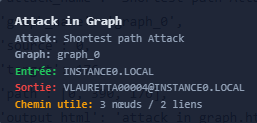
Output
The function returns:
- The shortest valid path between source and target
- Intermediate nodes and relationships used
- A minimal-step attack chain representation
Example of output

Technical Reference
For more details on the implementation, you can click on this link:
** attacks creation python module **
Summary
- Shortest Path = minimum-step attack route
- Based on graph distance optimization
- Not tied to a single exploitation technique
- Can mix multiple AD relationship types
- Helps identify most exposed privileged targets