Opportunity Attack
What is an Opportunity Attack?
The Opportunity Attack is a graph-based attack model based on a random walk strategy in an Active Directory environment.
It simulates an attacker moving without a predefined strategy, stopping only when reaching predefined high-value targets.
Definition (Project Scope)
An Opportunity Attack is defined as:
A random traversal in the graph starting from any node, progressing step by step, and stopping when a target of interest is reached.
Key Idea
Unlike structured attacks, this model does not follow optimal paths.
Instead:
- The attacker explores the graph randomly
- No prior knowledge of the environment is required
- Success depends on opportunistic discovery of targets
Targets typically include:
- Privileged groups (e.g., Domain Admins)
- Sensitive accounts
- High-impact nodes
Opportunity Attack Detection
A valid attack path is:
- A random walk starting from any node
- A sequence of valid graph transitions
- Ending when a target node is reached
There are no strict constraints on:
- Path length
- Relation types
- Structure
Execution Block
louise = attacks.run_louise_attack(
    jsonl_path= graph,
    min_success = 150,
    min_nodes_for_long = 12,
    max_attempts = 10000000,
    max_steps = 100,
    show_paths = True,
    show_long_paths= True
)
- Launch large-scale random explorations of the graph
- Control the number of successful paths (
min_success) - Define long path thresholds (
min_nodes_for_long) - Limit exploration (
max_attempts,max_steps) - Display discovered paths (
show_paths,show_long_paths)
Output
The function returns:
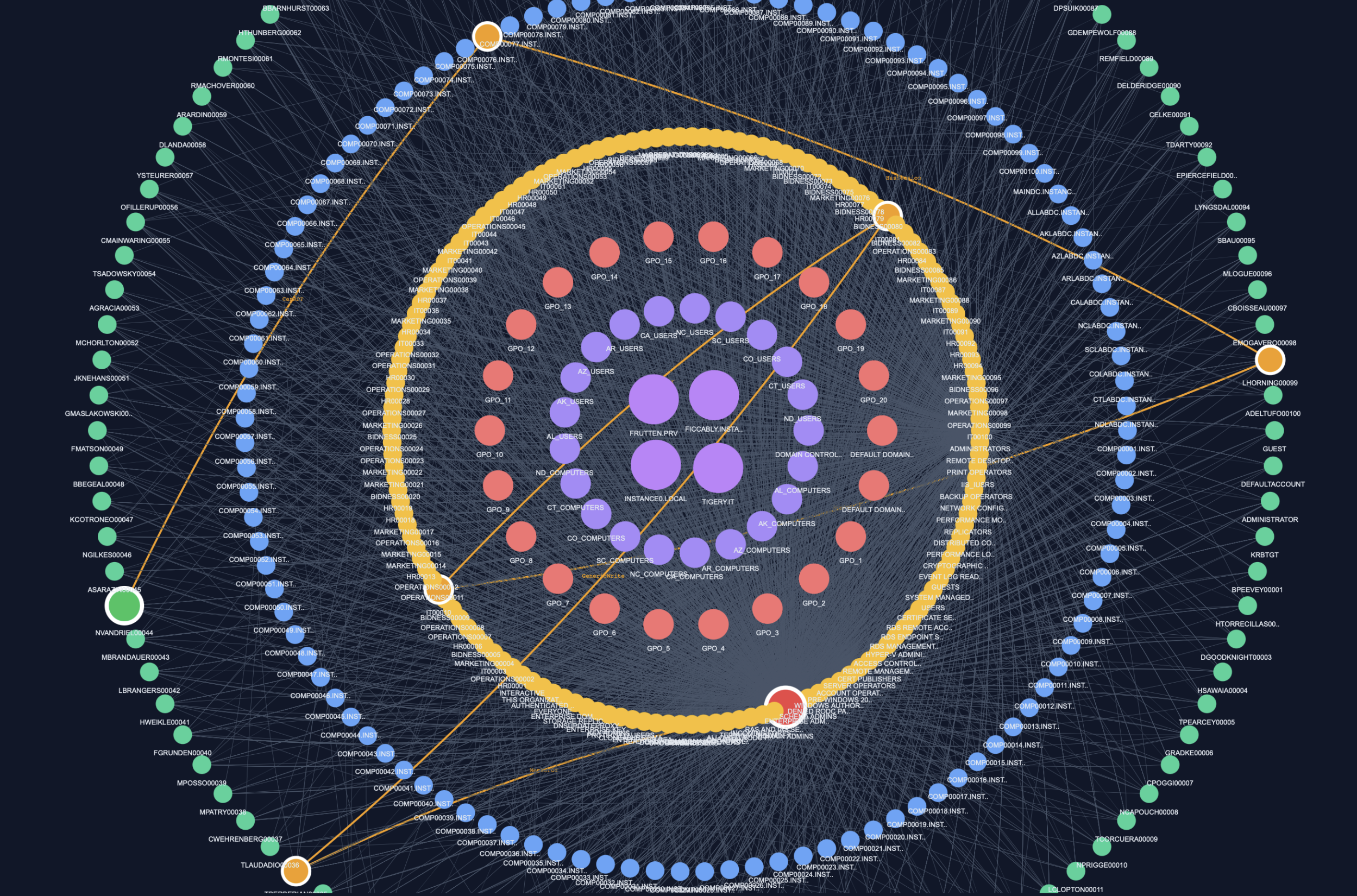
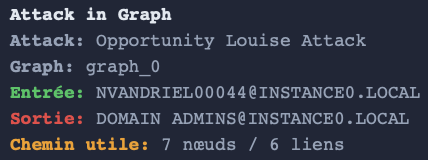
- Multiple successful attack paths
- Short and long opportunistic paths
- Source → target chains discovered randomly
Example of output
Technical Reference
For more details on the implementation, you can click on this link:
** attacks creation python module **
Summary
- Opportunity Attack = random graph traversal
- No predefined strategy
- Stops on high-value targets
- Reveals unexpected attack paths
- Simulates realistic attacker exploration behavior