Phishing Attack
What is a Phishing Attack?
The Phishing Attack simulates an initial intrusion where an external attacker targets users through a malicious email campaign.
The goal is to obtain valid credentials and gain a first foothold in the system.
Definition (Project Scope)
A Phishing Attack is defined as:
A probabilistic selection of users receiving phishing emails, where some accounts become compromised based on a success probability.
Key Idea
An attacker sends a targeted phishing campaign:
- Around 10 users are selected
- Emails mimic legitimate internal communication
- Some users ignore the attack
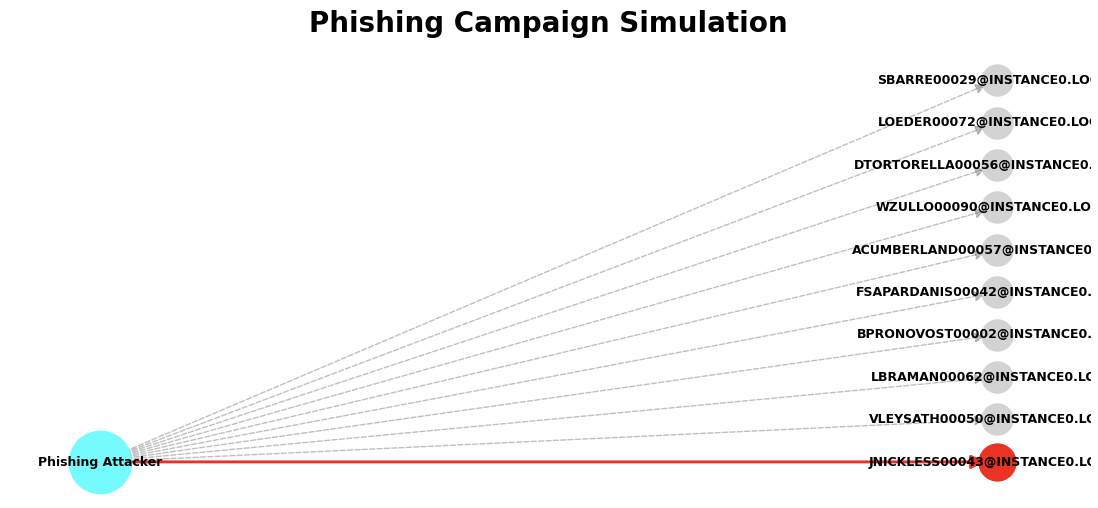
- Others click and submit credentials
This results in: - A set of compromised user accounts - Initial entry points into the graph
Phishing Simulation
The simulation performs:
- Random selection of users
- Application of a success probability (0% → 10%)
- Identification of compromised accounts
Execution Block
phishing = attacks.run_phishing_campaign(
    jsonl_path = graph,
    target_count = 10,
    prob_range = (0.0, 0.1),
    user_label = 'User',
    name_property = 'name',
    seed = None,
    show_plot = True,
)
- Select targeted users (
target_count) - Control success probability (
prob_range) - Define user node type (
user_label) - Ensure reproducibility (
seed) - Visualize compromised accounts (
show_plot)
Output
The function returns:
- Targeted users
- Successfully compromised accounts
- Initial access points in the graph
- Visualization of the intrusion phase
Example of an output :
Technical Reference
For more details on the implementation, you can click on this link:
** attacks creation python module **
Summary
- Phishing = initial access simulation
- Targets multiple users
- Uses probabilistic success
- Produces compromised accounts
- Acts as entry point for further attacks