JSON Format for Attack Simulation Paths
This document explains the structure and meaning of the JSON files generated during attack simulations. Each JSON object represents a single attack path identified in the environment graph. This file is created is the attack_datasets folder.
Overview
An attack simulation output is a collection of JSON objects. Each object describes:
- The type of attack performed
- A unique identifier for the attack instance
- The source and target nodes
- The path taken through the graph
- The relationships used at each step
Example of an attack dataset
Here is an extract of a shadow admin attack dataset.
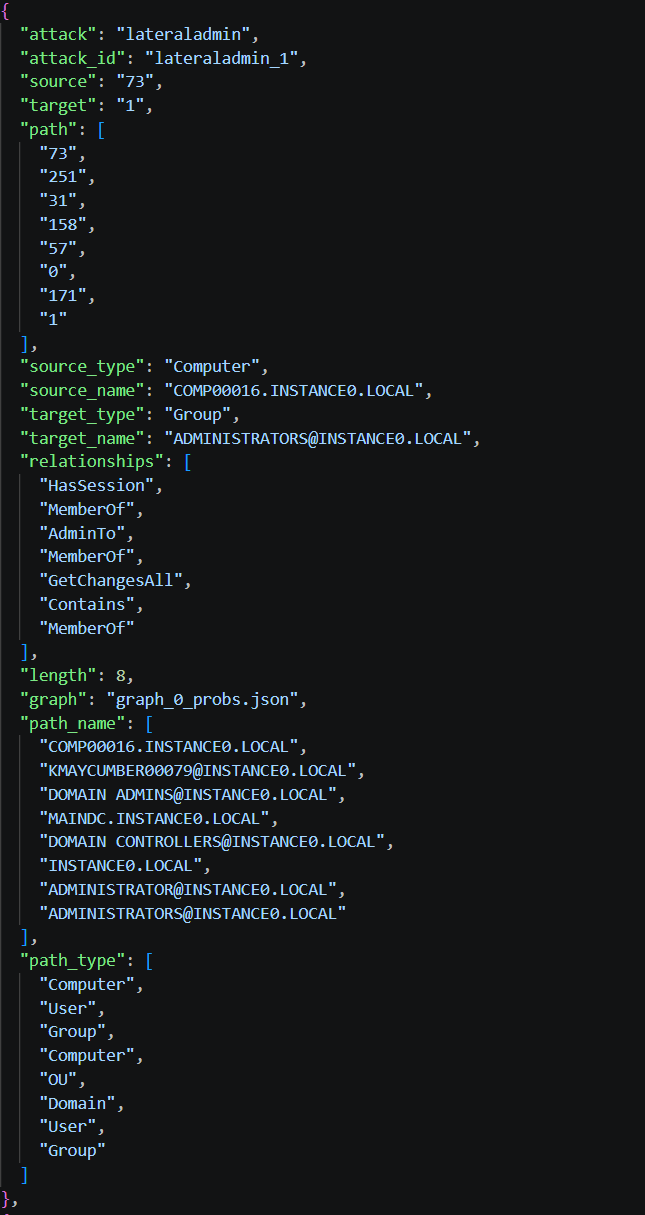
Field Descriptions
Core Metadata
-
attack
The name of the attack technique used (e.g., shadowadmin, shortestpath,...). -
attack_id
A unique identifier for this specific attack path. It is constructed with the concatenation of the attack name and its number.
Source and Target
-
source / target
Internal IDs of the starting and destination nodes. -
source_type / target_type
Node types (User, Computer, Group, Domain, etc.). -
source_name / target_name
The label of the nodes as they are written in the AD graph.
Path Definition
-
path
Ordered list of node IDs from source to target. -
length
Number of nodes in the path. -
relationships
It is the path the attack has taken in terms of relationships. -
path_name
Ordered list of node names (labels) from source to target. -
path_type
Ordered list of node types from source to target.
Graph Reference
- graph
Name of the AD graph file used to launch the attack.
Consistency Rules
- len(path) == len(path_name) == len(path_type)
- len(relationships) == len(path) - 1
- Ordering must match across all arrays